First in the series
Five Mindset Lessons for Beginning Interventional Radiology
Humility, learning and unlearning, mentorship, confidence and patience in the early stages of training.
Read the blogRetrain Empower Transform

R-E-W-I-R-E with Dr. DeepaShree
A doctor exploring the brain, the mind and the inner self.
Through REWIRE, I bring neuroscience into conversation with meditation, self-awareness and spiritual reflection, helping you understand your thoughts and emotions and make more conscious everyday choices.
Open the REWIRE appNew · For residents and aspiring IRs
Practical mind tools for the learning journey, from becoming a beginner again to growing with confidence. Explore the mindset we bring to learning, mentorship and the challenges of training.
Explore REWIRE for IRFirst in the series
Humility, learning and unlearning, mentorship, confidence and patience in the early stages of training.
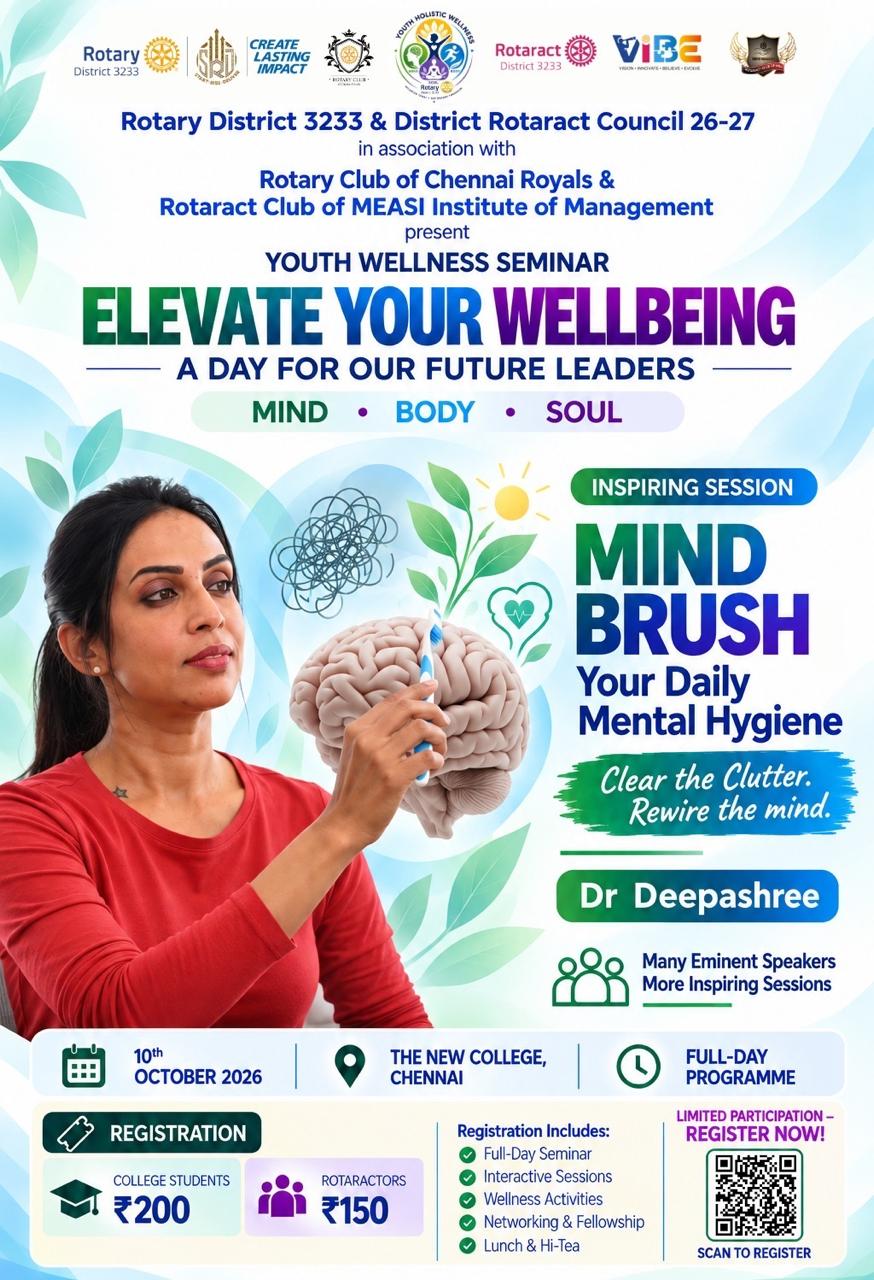
Read the blogEvent recap · 10 October 2026
Elevate Your Wellbeing · Youth Wellness Seminar
Clear the clutter. Rewire the mind.
We brush our teeth every day. What about the thoughts we carry? At The New College, we explored how to notice mental clutter, pause, and make room for a more conscious response.
Presented by Rotary District 3233 and District Rotaract Council 2026–27, in association with Rotary Club of Chennai Royals and Rotaract Club of MEASI Institute of Management.
Watch the moments
A glimpse of the conversations and energy from the Rotary youth wellness event at The New College, Chennai.
Event highlights · 58 secondsA space to talk
If you would like to speak with Dr Deepa about a relationship or personal concern, contact Kalpana to arrange the next step.
Five familiar moments
Choose one moment that feels familiar. Start with one small pause.
In your messages
A short reply leaves you rereading the conversation and guessing what went wrong.
A moment to pauseWhat do you know, and what are you assuming?
When someone needs a favour
You agree before checking your own capacity, then feel stretched and resentful.
A moment to pauseCould “Let me check and get back to you” give you time to choose?
After a conversation
One difficult remark takes up more space in your mind than everything that went well.
A moment to pauseWas the feedback about one action, or have you made it a judgement of yourself?
A few minutes on your phone
Someone else’s highlight leaves you wondering whether your own life is falling behind.
A moment to pauseDo you want their life, or the feeling you imagine it would give you?
When you finally get home
You stay composed all day, then snap at home when one more thing is asked of you.
A moment to pauseCould “I’m stretched today. Give me a moment” help you pause?
Recognised yourself? Explore the six REWIRE steps
A little space to choose
You might still feel worried, disappointed or irritated. There can also be room to ask a question, take a pause or say what you need.
R-E-W-I-R-E gives you six prompts to work through a moment like this, from recognising a pattern to choosing what you want to practise.
“I’d like to think about that before I answer.”
“Can you help me understand what you meant?”
“I can help tomorrow, but I can’t take this on today.”
The R-E-W-I-R-E approach
Begin with one moment you recognised above. Move from noticing your reaction to choosing what you want to do next. Explore each step below.
01 / Recognise
What happened? What did you feel? What did you immediately want to do? Awareness is the starting point.
“When someone doesn’t reply, I notice myself checking my phone again and again.”Name the pattern. Not a flaw.
02 / Externalise
Practise describing an emotion as an experience you are having, rather than making it your whole identity.
“I notice anxiety arising” instead of “I am an anxious person.”Acknowledge it. Make a little space.
03 / Witness
Pause and notice your body, thoughts and urges. There is no need to empty your mind or make a feeling disappear.
“My shoulders are tense. My mind is telling a story. I can notice it before acting.”Eyes open, eyes closed, or a gentle pause.
04 / Interpret
Explore other explanations without forcing positivity or dismissing real concerns. What do you know, and what are you assuming?
“No reply yet is a fact. ‘They don’t care’ is an interpretation. I may need more information.”Be balanced. Not blindly positive.
05 / Respond
A conscious response can be a question, a pause, a repair or a clear boundary. Practise the words you actually want to use.
“I’ll pause, decide what I need, and ask for clarity instead of sending another frustrated message.”Calm can still have a backbone.
06 / Empower
Choose one repeatable action within your control. Give yourself a cue to practise and permission to begin again.
“The next time I feel the urge to react, I’ll take a short pause before choosing my next words.”Practice, not perfection.
Science & Spirituality
Meditation and witnessing invite us to notice our inner experience. Neuroscience explores how these practices relate to attention, emotion and the way we respond.
Fear & clear thinking
The amygdala helps detect emotionally important events, including threats. It communicates with the prefrontal cortex, which helps us weigh choices, hold information in mind and regulate our responses.
Under intense stress, fight-or-flight systems can take priority and prefrontal control becomes less effective. Thinking flexibly gets harder. “Amygdala hijack” is a metaphor for this shift; the thinking brain does not literally switch off. [1]
Witnessing & self-awareness
In a brain-imaging experiment, labelling emotional images was associated with lower amygdala activity and greater activity in a prefrontal region involved in regulation. [2]
A practical parallel with witnessing is to notice, “I’m feeling afraid,” before choosing a response. This connection is an interpretation of the study’s emotion-labelling findings.
Meditation & practice
Meditation involves noticing when attention wanders and gently returning. In a small eight-week study, mindful-attention training was followed by reduced right-amygdala responses to emotional images overall, even outside meditation. [3]
This suggests that emotional processing may change with practice. It does not mean fear disappears, or that every type of meditation has the same effect.
The connection is practical: notice what is happening within you, and make room to choose your next response. These studies examine specific practices; they do not test the REWIRE programme as a whole.
Meet your facilitator
Doctor & Head of the Department of Interventional Radiology

Event co-facilitator
NLP practitioner
Watch and reflect
Explore these REWIRE reflections, then browse the short videos and reels below. Take the idea that speaks to you into your day.
Love, growth and the thoughts we choose to give our attention.
A tree cannot thrive if it keeps shrinking to fit someone else’s space.

Hold on to love while making space for another person’s choices.
View full image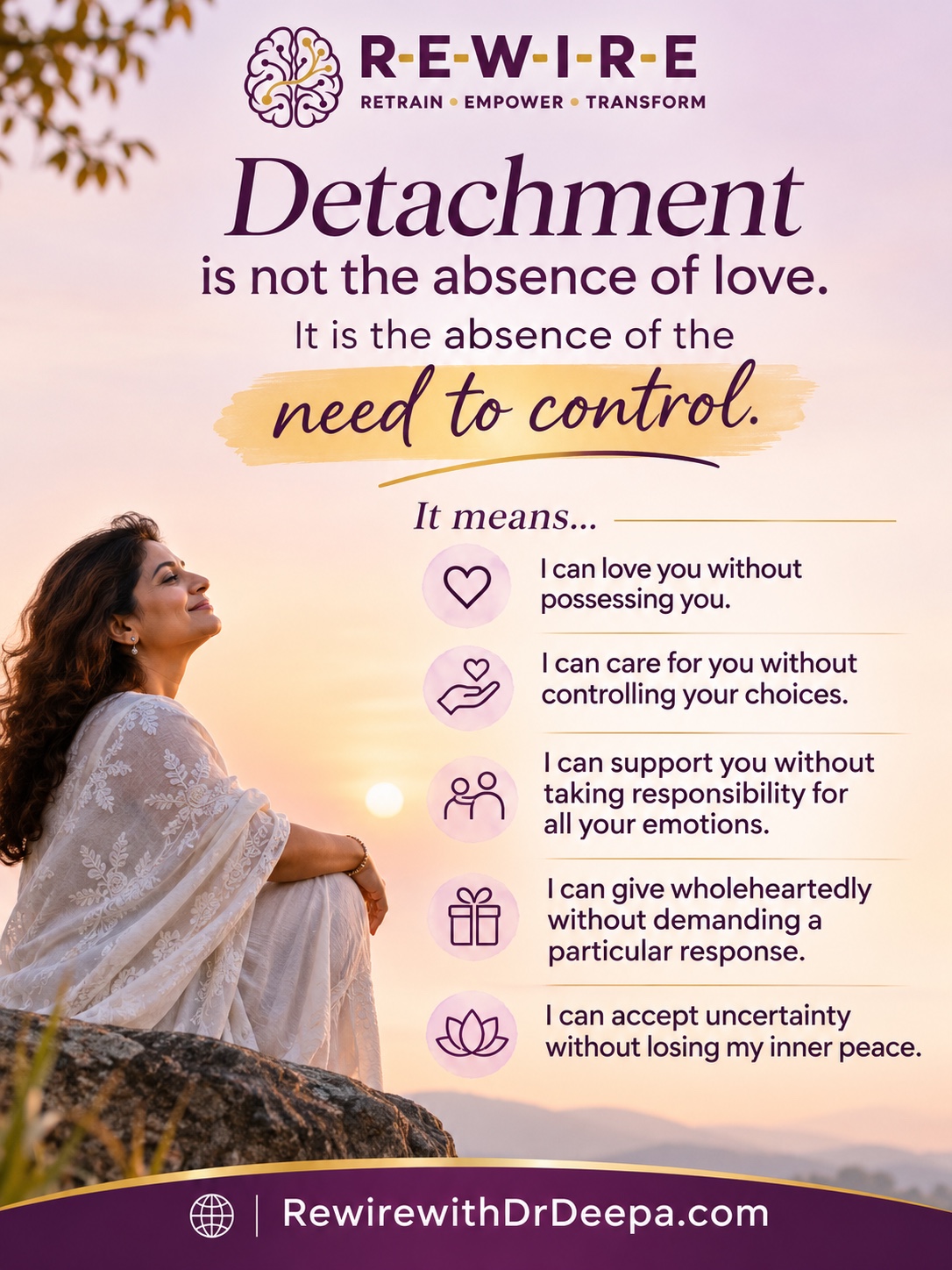
Five gentle reminders for loving and caring with room to breathe.
View full image
Notice the thoughts you keep feeding and what they bring into focus.
View full imageA visual way to notice the mental residue that builds up through the day.
Sort a passing thought into what matters, what can wait, and what you can release.
Notice the story that appears before you decide whether to call again.
A short glimpse of a practice for observing thoughts without following each one. Explore Rewire Mind Reset.
Watch the featured reels and join the conversation there. If a player doesn’t load, use its button to open the reel on Instagram.
From the REWIRE workshop archive
Our September workshop was an activity-based experience, with time to reflect, try the six steps and turn one useful insight into an everyday action.
Explore a manageable everyday situation.
Use reflection, guided pauses and conversation.
A small commitment you can put into practice.
No prior knowledge of the framework is needed. Come with curiosity and one everyday pattern you would like to explore.
No. Sharing is always optional. You can keep your reflections private, choose a lighter example, or pass on any activity.
For future REWIRE workshop enquiries, contact Kalpana K. New dates will be shared here when confirmed.
 Community edition
Free community booklet
What do I do when jealousy appears? Does forgiveness mean staying in a relationship? How can I pause before reacting? This Q&A booklet brings together the questions and practical reflections shared in our community.
Explore the mind, emotions, relationships, daily practices and meditation. Read a question, try the reflection, and return whenever you need a little perspective.
Continue the practice
If you recognised yourself in these moments, this is a place to work through your own. Bring one situation to the page and explore what you’d like to try next.
Select a page to read it in full.
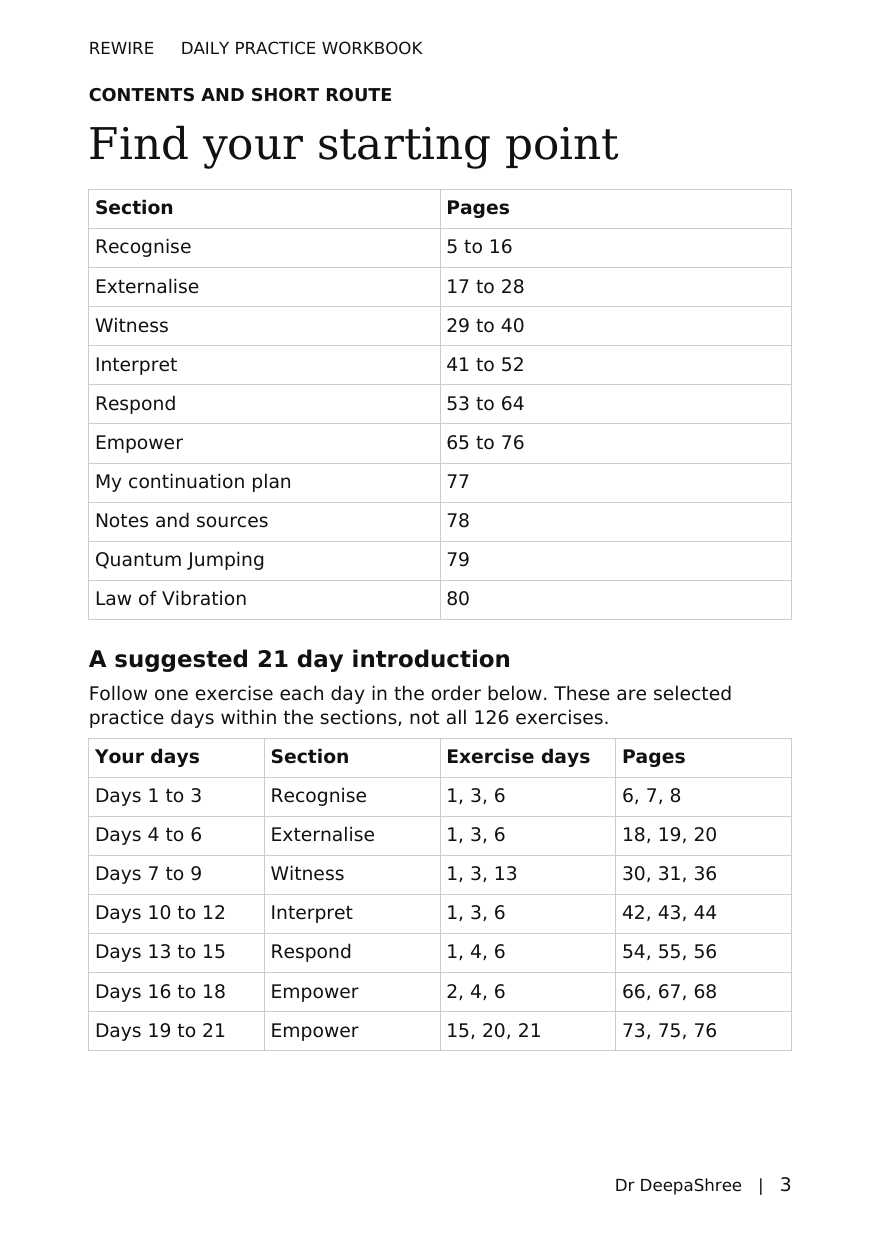
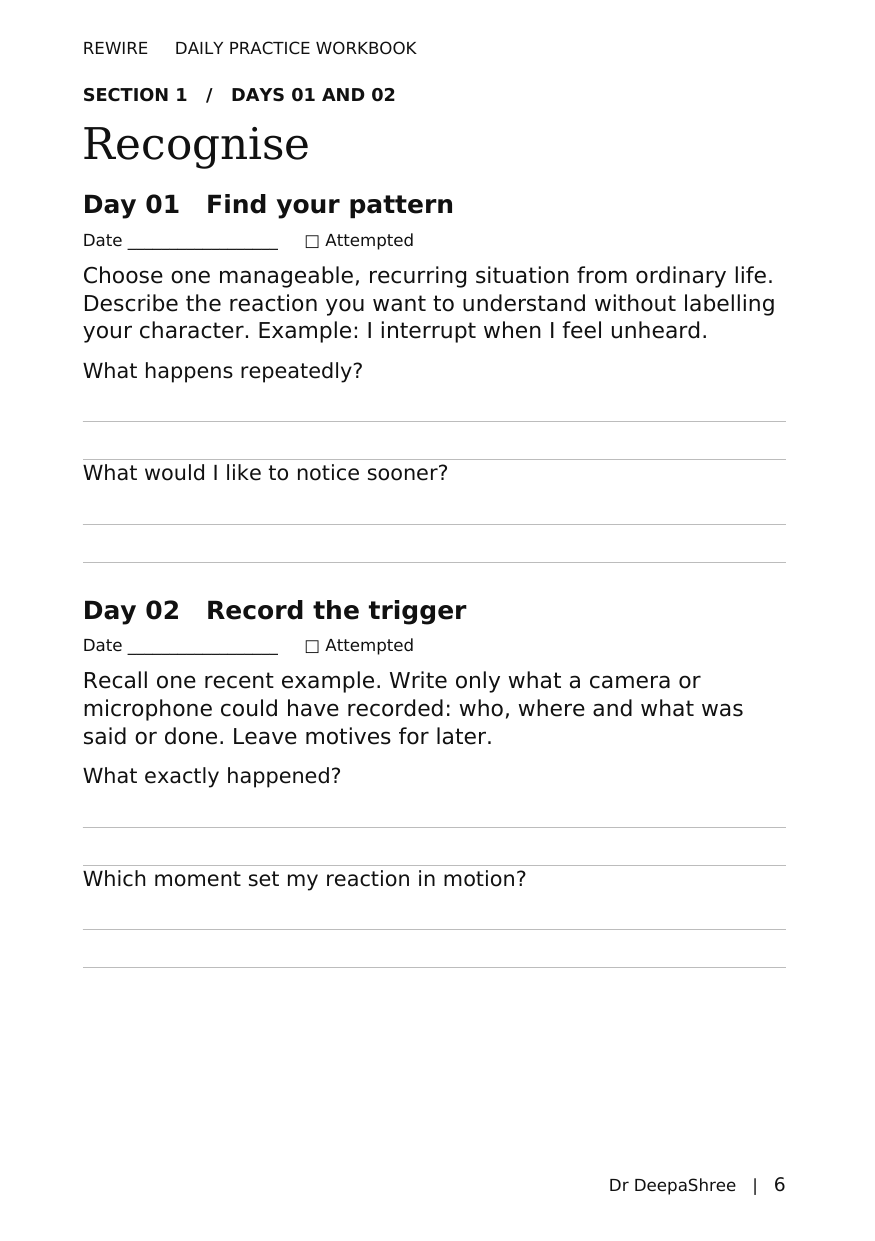
21 days for each letter
Make a little space for yourself each day. Explore all six REWIRE stages through 126 guided exercises, with prompts to notice your patterns and practise a more conscious response.
PDF e-book 80 pages
Special offer
Regular price ₹899Offer price ₹499
Email to place your order and request payment and delivery details.
manifest@rewirewithdrdeepa.com